Which continent, exactly?

This blog's title isn't in reference to actual continents (I've now been to four), but is rather drawn from "The Third and Final Continent," a stunning short story by Jhumpa Lahiri, from her collection, The Interpreter of Maladies. In particular, I'm inspired by the following quote that summarizes the attitude I try to carry with me through life and on my travels

I am not the only person to seek his fortune far from home, and certainly I am not the first. Still there are times I am bewildered by each mile I have traveled, each meal I have eaten, each person I have known, each room in which I have slept. As ordinary as it all appears, there are times when it is beyond my imagination.

I love this. It calls on us to consider the tiny details of our experiences, both one-by-one, and in the aggregate, and to maintain a sense of wonder even about the seemingly mundane things that are the building blocks of our lives, and often, the glue that binds us to our traveling companions.

This blog began as a chronicle of my study abroad experience in Cairo in Spring 2008, and continued last year while volunteering in Geneva, and South Sudan with a wonderful organization, VIDES.

Now in graduate school, I'm returning to the Continent this summer while interning in New Delhi, India.

Please enjoy, inquire, and learn.

Thursday, February 14, 2013

Nothing More Romantic Than Hate Crimes in Russia

Happy Valentine's Day, dear readers.

I spent the whole afternoon at CERD, the Committee to Eliminate Racial Discrimination, as the Russian Federation presented a report and then was grilled, thoroughly, but diplomatically about their treatment of minorities and migrants, including major issues like treatment of Roma (Gypsies), Neo-Nazi groups and other violent extremists who target ethnic minorities, and land and economic rights for  the indigenous peoples who tend to populate fossil-fuel rich areas.

It was kind of a sobering contrast with what today is "supposed to be," whatever that means. Never been a fan of Valentine's day.  It's different for everyone, but for me it seems an attempt to candycoat everything and fit relationships, romantic and otherwise, into a prepackaged heart-shaped box, when what's really important are the unique ties between peoples, those that acknowledge  pockmarks and imperfections, and then seek to fill in one another's flaws with the most generous love we can muster.  The candy version seems so insubstantial, especially as I was vividly reminded of man's inhumanity to man.  Sad about being single on Valentine's Day?  Imagine being a Chechen or Roma in Russia. . .

These meetings do get a little long and repetitive, as every speaker "warmly welcomes the delegation," and then throws down their two cents of well-phrased criticism.   My mind started wandering to things like, "If you don't love me back, it'll be a crime against humanity. Be Mine."

I'm a terrible person.   Don't let me bring anyone down.  Have a beautiful day.

Love from Geneva,
Laura


Wednesday, February 13, 2013

Brought to you by a bunch of Tubes.

For the second time, this entry is inspired by the letter E, for Economist (I promise they aren't paying me, but that would be nice.  Or give me a print subscription that keeps up with my vagabonding ways)
Earlier this year, they ran a review of the book Tubes, by Andrew Blum, on the history, infrastructure, and geography of the Internet.  This is an issue that has fascinated me ever since the Internet broke when I was in Cairo thanks to a couple of ships whose anchors nicked the undersea cables connecting us to Europe (that's the most widely held story, though conspiracy theories abound).  That experience, not unlike the one that sent Blum in search of the internet, alerted me to the existence of the cables, and to the idea that if we couldn't connect to Europe, then it was very possible my emails were traveling the other way around the planet, through Asia.  Mind. Blown. 

 I just got around to reading Tubes recently. I highly recommend it if you have the time.  It's a mix of tech, history, geography anthropology, and makes me think about using the web, such as writing this blog or the seemingly instantaneous communication with my friends, family, potential graduate schools, and favorite news sources with Email, Facebook, texts and calls via Google Voice (Google should also pay me), very differently. 

In short, "the cloud," is a myth.  Your pictures, videos, emails and personal data, and this blog entry, are stored in very real places, real server farms somewhere, close to you or not.  And when you access this data from wherever you are, it is transported through very substantial fiber optic cables under the ground, above your heads, across the ocean, connections wrought and managed by very real people.  Yes, much is now wireless, but the tubes and the people who make them work, although invisible to the naked eye, are always in the mix, somewhere.  

So now when I get to videochat (again, thanks to Google) with three of my wonderful friends from DC who have dispersed throughout the country (image and likeness used with permission, kind of), I picture the tubes. . . how the signal, composed of pulses of light, is somehow making its way to London, bouncing between New York and London, and winding its way to my friends' homes in three very different cities in the Midwest, South and East.   A company called Telegeography maps global connections and information flows.  It's really cool, and you don't even need to be a map nerd like me.  Check it out. 
Map produced by Telegeography. 
Check out the interactive version.
The reality of the connections tests the limits of my imagination. I understand just enough to think it's an incredible marvel, and be intrigued about the politics and people behind it. 

And I understand just enough to have a real sense of awe and gratitude for it.  I can't really imagine this experience without it. I am grateful that I am getting to travel the road less traveled, but don't have to put my relationships on hold, or miss the chance to get support from afar and share my journeys with friends and family. None of that "I'm going to Africa forever and will write you letters occasionally, and they will possibly reach you," nonsense."  I know intellectually that people have done it for thousands of years. . . many without hope of seeing each other or communicating at all, ever again.  But the actual sensation of doing so is foreign to me.  The modern world has its challenges, but I am happy to have the opportunity to travel through the Tubes to my friends, family and the maybe 2 strangers out there reading this thing. 

Saturday, February 9, 2013

How is this my life? Vol. 1: Food

Dear Mom:

I know what you're going to ask.  Am I eating well? the answer is: undoubtedly yes.  Too well, in fact.  

In the past few days, I have had:  
  • An average of 2 cups of espresso daily.  One at breakfast, once at lunch
  • Fruit and vegetables at every meal.  The salad comes with aglio e oglio (oil and vinegar), so is  simple and delicious. 
  •  Italian fresh mozzarella, French Gruyere, along with killer charcuterie.
  • A small glass of French wine maybe every other day for dinner.   And on Sunday, we had champagne, just because it was Sunday
  • Nutella out of a small pail (at right), to have on whatever I'd like
  • Various cakes, pies, and homemade desserts
  • French and Italian entrees: Chicken Cordon Bleu, Penne Bolognese, Flank Steak.  Lasagne. 
  • This weekend, an Iranian friend of one of the sisters brought us a delicious rice and meat dish with yogurt sauce. I've been craving my hummus and other favorite flavors from this part of the world, so this was giant spoonful of heaven (which tastes like seasoned rice and meat, in case you were curious) for me. 
  • 2 bars of Swiss chocolate to celebrate the Feast Days of St. John Bosco and St. Francis de Sales, the founder and spiritual inspiration for the Salesians.  
  • Homemade crepes with the aforementioned Nutella
Almost every day I have the realization about how lucky this makes me.  And to quote my friend Maria Paula, it always evokes the question, "How is this my life?" (MP usually used this for absurdly unpleasant experiences, but I think it works just as well for the good)

Happy Mom?

Love,
Laura


I could go on, but that would just be mean. And there's a larger point in this (this post was not supposed to end up here, but it did). 

I was describing this to my friends back home, which raised the probably obvious question . .  How is that a life of poverty and simplicity?  It's an interesting question, and here's my best attempt to answer it as I understand things.

Community dinner. 
Yes, the community is comfortable, but far from opulent, really, quite simple, relative to the community it serves (I have not yet witnessed poverty as I understand it in Geneva). And above all, it's a community of collective comfort but individual humility.   As a member of the community who is contributing in my small way to part of its mission, I have the privilege of participating in community meals, as delicious and nutritious as they are.  But it is not my food, and I am not entitled to it except insofar as I am participating in the community.  I do not have a cubby of food with my name on it that no one else can take and I do not choose what I want to eat this evening.  The sisters have a little more say as these things are their responsibility, but in general, all find out what is for dinner, and enjoy it gladly and gratefully.

There's something beautiful and liberating about this. . . like I've written previously, DC by the end was a little exhausting with all the little choices I had to make (apparently this is a real phenomenon known as "decision fatigue"). I was constantly playing mental tug of war with the world trying to make the most of my highly finite time and money.  Now those decisions are made apart from me, either by one of the sisters or simply by the routines that have been built in the community and wider culture over the decades (both European and Salesian culture definitely have deeper roots than I'm accustomed to.)  The constant act of deciding, the tug of war has been outsourced.
Trading my burger and beer
cravings in for espresso,
pannetone and gruyere.

But in roughly 6 months, I will reenter the world and be thrown back into a world of a million choices, of greater autonomy.  And it will be nice to eat according to my cravings, and enjoy the American fashion of appropriating everyone else's food, manipulating it in some way and then eating cuisines from a different continent every night.  And when not overwhelmed by choice, it can be extraordinarily rewarding to procure my ingredients and manipulate them to produce something  new and delicious.

But the constant choosing may become a burden once again, and I do not know if the regained freedom of choice will be harder after these few months of life in community, or easier thanks to these months of reprieve and personal development.  I will find out, for better or for worse.   But in the meantime, I am embracing this life of delicious simplicity.

Dinnertime. Ciao for now!

Laura
Slightly more candid, Simon-Pierre included.  

Sunday, February 3, 2013

Taken from the IIMA Blog: Israel's No-Show


While a more substantial reflection on my work here (among other things) is, per usual, forthcoming, I thought I would start by sharing a sample of what I've done so far, a blog entry on Israel's non-participation in the Universal Periodic Review, a first-ever occurrence that poses a significant challenge to the Human Rights Council.  I had the opportunity to attend the session and see the diplomatic drama go down.  It was definitely something that attracted a lot of attention locally. Seats that often remain empty were filled with a number of people from every acronym imaginable (usually the reverse of the ones I'm famliar with from DC. . . FMI, BW, etc. )


And here's the entry from the IIMA (Salesian Human Rights Office) blog, (English edition).  The original draft was written with the help of my wonderful colleague, Sofi from Mexico. 

Enjoy!


On January 29, 2013, the State of Israel was scheduled to undergo its second Universal Periodic Review (UPR), but the Israeli Mission to the UN did not present its report to the United Nations Human Rights Council (HRC), or attend the designated session.

Other States made statements regarding this unprecedented occurrence. Many shared the concern that by breaking the pattern of cooperation, Israel has opened the door to non-cooperation by others. All States present expressed enormous respect for the UPR, but disagreed about how to respond to the situation in order to preserve the universality and integrity of the mechanism, and thus, its unique role in promoting human rights.

HRC President, Mr. Remigiusz Henczel, distributed a draft decision proposing a way forward in the case of Israel, and as a precedent for any future instances of non-cooperation.   The proposal called for the President to engage with Israel and urge it to resume its cooperation.  If he succeeds, its UPR will be rescheduled for 2013.

As the meeting concluded, the resolution passed by consensus. Many States and observers hope that the on-going formation of a new Israeli government will lead to re-engagement with the HRC.

---


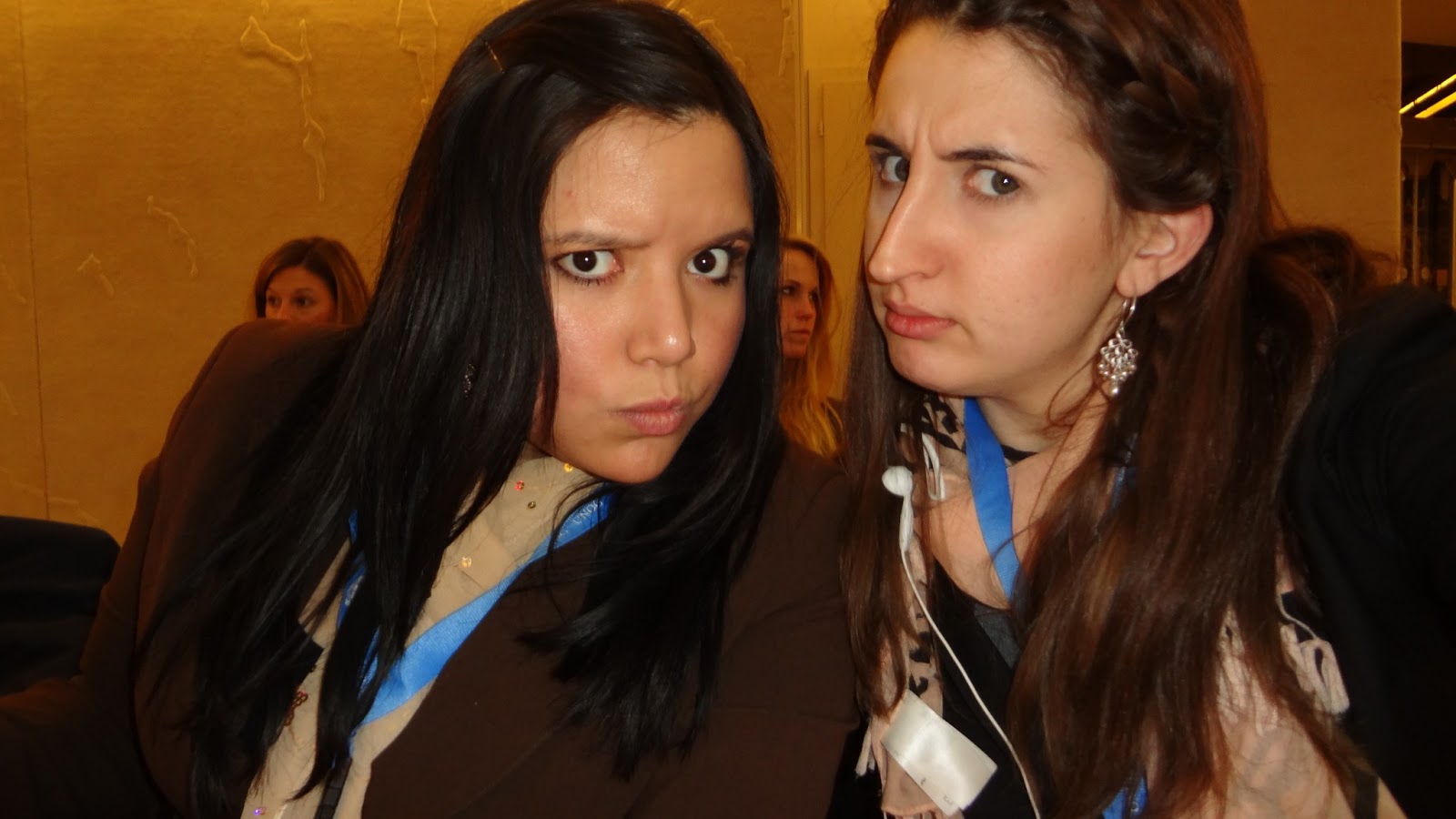
On a less professional note, Sofi and I
giving our WTH Israel faces. . . 

Friday, February 1, 2013

Semi-brilliant in one language, an idiot in several.

Buon Giorno!  Buenos Dias!  Bonjour!  Welcome to my life.

As someone who claims to love languages and has tried to learn several of them, I never expected to feel so outgunned.

My repertoire is as follows: English, good at understanding and reading Spanish and can speak it enough to express basic ideas, a bit of Italian (hi, how are you, my name is Laura! Thank you! You're Welcome!), about the same in Farsi, and moderate, but rusty Arabic.

The predominant language in Geneva is French.  Mass here at the convent is in French.  But living with so many Italians I frequently forget that I'm not in Italy.

My community now consists of the following (sorry housemates if I've "misunderestimated you"
  •  A Mexican Amiga: Speaks Spanish and good English
  • A French Dude: Speaks French, Spanish, and is working on English
  • An Italian Guy: Speaks Italian, Polish, Pretty Good Spanish and good English
  • An Italian Lady:  Speaks Italian, good English, and Spanish
  • My boss, an Italian Salesian Sister, speaks Italian, French, Spanish, and OK English
  • Two Italian Salesian Sisters, who speak Italian, French, some Spanish and hardly any English
In case you want that data visualized, here you go


What this means is that I'm the only one who can't communicate effectively in Spanish, Italian or French.

In a lot of ways, English here functions as the lowest common denominator, spoken only when necessary, and often translated exclusively for me.  I sometimes try/have to speak Spanish, at which point I'm pretty sure my linguistic talents sound somewhat like Colin Firth trying to speak Portuguese in Love Actually, except I lack both the good looks and charming accent of Colin Firth.


I'm aware this is really a good thing, a valuable learning experience, the kind of international experience I've always dreamt of.  Those who know English happy to translate for me. I'm getting better at understanding Spanish and Italian, to the point where I get the idea long before the translator has time to do his/her magic.  I also realize that my English writing and editing skills, honed over years of quality education and work experience make me uniquely valuable to the work we do here.  When editing English documents written by non-native English speakers, I can spot the awkward phrases, the wrong preposition or a missing article from what feels like a mile away.

Except for my pride.  My pride doesn't like this one bit.  I love languages.  I love the intellectual challenge; I love being able to  make connections with people who I wouldn't be able to communicate with otherwise.  And I don't like being bad at things I care about. I don't like sounding like Colin Firth speaking Portuguese (English would be OK).  I don't like listening to political discussions in a mix of French, Spanish, and Italian and understanding the main topic of discussion, but falling short of getting the fine points of the argument or throwing in my two cents.  Or a full Swiss Franc's worth (My friends might tell you my rants/lectures are at least a few Euro).

Lost in translation in Panama City?
But I chose to put my Spanish aside to start Arabic,  haven't really studied Arabic since 2009, never picked up Italian again after 8th grade, and now am not really useful for more than the basics in anything but English.  And now, I sometimes wonder if I should have just kept with Spanish.  I frequently wish I had the self-control to make myself learn languages independently, so I could have spent a couple of hours on Arabic every week.  But if wishes were horses. . .

Which brings me to another point.  I've also learned my English is bad.  I talk too fast (bringing back memories of when one of my students in Egypt wrote on his evaluation "Kill Laura, or tell her to talk slower.") and my Southern-Midwest accent is apparently harder to understand than when I fake a British accent.  I can't use phrases like "if wishes were horses," "the odds are," "my two cents" "easy on the eyes," and such things and actually be understood.  I really try to speak more slowly, use more generic vocabulary, but it's been hard to make the adjustment. Especially since my sense of humor is very  wordplay- and irony-centric, I'm pretty sure my new friends think I'm just really weird.

I AM OK with being
 bad at heiroglyphics.
Yes, I'm whining. I know in my heart this new situation is a blessing in disguise for me; in Egypt, I almost never had to speak Arabic except in class, and so failed to develop spoken Arabic like I'd hoped.

Really, if my only complaint is that I'm not better, then I just need to work harder.  Hopefully once I wrap up the process of finishing up my business from the States (paying last bills, a few loose ends on grad school applications) I can spend some of the quality time this simpler lifestyle allows reviewing Spanish vocabulary, Italian grammar, and maybe some Arabic in anticipation of VIDES Part 2: South Sudanese Edition.

Sorry for the whiny entry, dear readers.  Needed to get it out of my system.  Next up, the most global language of all: FOOD.

Ciao for now!
Laura


Saturday, January 26, 2013

A Tsunami in Geneva?

Lake Geneva, 1.26.13
Yes, you read that right.

Anyone who knows me personally knows of my strong affection for the Economist.  I love it for a number of reasons, including that it addresses in detail, global events and issues I never would have known or even considered.

Such as this article, "Lake Monsters: Tsunamis on Lake Geneva," which I read a few months ago, and with my plane ticket already booked, I haven`t been able to get it out of my mind.

Apparently, a) lakes can get tsunamis and b) Lake Geneva has had a history of them, the latest of which was in 563 AD.  At that point the New World (as defined by Europe) wasn`t even a glimmer in anyone`s eye, but there was enough of Geneva there for bridges, windmills and nearby villages to be wiped out.   Conventional wisdom said it was a one-off caused by a rockslide, but recent research suggests it may have happened before, perhaps 5 times in the last 13,000 years.  Science is pretty cool, no?

So the odds are extremely good that I won`t experience a tsunami while I`m here.  But it's not impossible. I`ve used this article to help put my inexplicable love of the Middle East and next placement in Juba into perspective for those who simply think: "Africa/Middle East=scary and dangerous."  Yes, the news reminds us daily that these regions are dominated by developing countries at risk for instability. Still, what the news doesn't always get across is that these places are homes to millions and billions of people, including foreigners and expats, almost all of whom will get up tomorrow and go about their days in peace. We're wired to be awful at risk assessment, and media bias only makes it worse.  Of course, I'm absolutely taking risks with my choices of locale, and I will have to exercise a great deal of caution anywhere I go, monitor the social and political situations that affect me closely, and take measures like registering with the State Department.

But Juba, Cairo, and their neighbors are not the only place where bad things happen, and I try to keep that in perspective.  I could get hit by a car in St. Louis,  get struck by lightning, or, apparently, experience a tsunami in Geneva.  If I let scary unknowns put me in a permanent state of fear, if my life decisions perpetually overcount the potential dangers and undercount the incredible things I can do and experience, well that`s so much worse than facing a once-in-a-few-millennia tsunami striking a landlocked country and destroying one of the world`s wealthiest cities.


Friday, January 25, 2013

Where in the world is Laura . . . exactly?


It is 6pm on a Friday, and I am in the final stages of kicking jet lag, so rather than give details about what life is like here or what world-changing stuff I`m working on, it is easier to just throw a Google map up here to at least give you the where, and save the what, the why, and the how for later, especially because I am still figuring most of that out anyway, and will be for a while.  

Also, despite my best efforts, I haven`t acquired an adapter for my electronics, so I`m working on a laptop that appears to be set up for French, as the y and the z are reversed, along with a few other significant changes.  Which leaves me trzing to tzpe like this, and itàs driving me totallz crayz.   Absolutelz bonkers. 

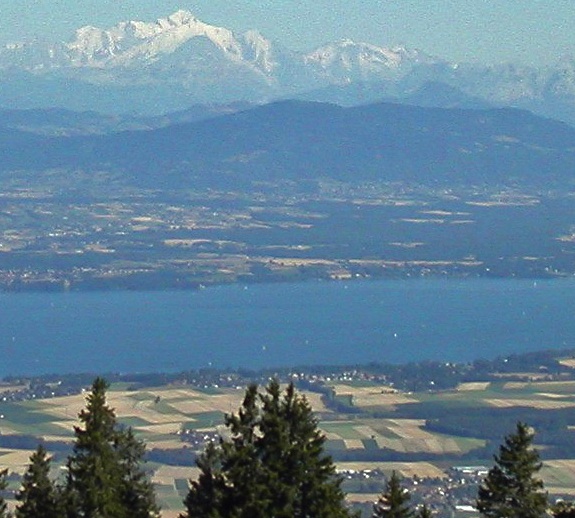
So, anyway, back to where.   The Salesian school/residence and the IIMA office is located Veyrier, a small town/village outside Geneva, roughly 20-30 minutes by bus.  In practice, we`re closer to France than we are to Geneva, but it appears to stay pretty quiet over there.   The backdrop here at the office are these two pretty incredible mountains that the map tells me are in France.  They`re are probably small for Colorado or Nepal, perhaps, but for this Missouri girl, these are no molehills.   Waking up to snow-covered Alps every morning are just another aspect making this experience totally surreal. 

Then, I will be spending a good amount of time at the United Nations Human Rights building, which is a bus ride away. I just got my badge today, so I can get in with ease on Monday.  Again, surreal.  More on the actual work next week once that starts and the reality hits a little more soundly.